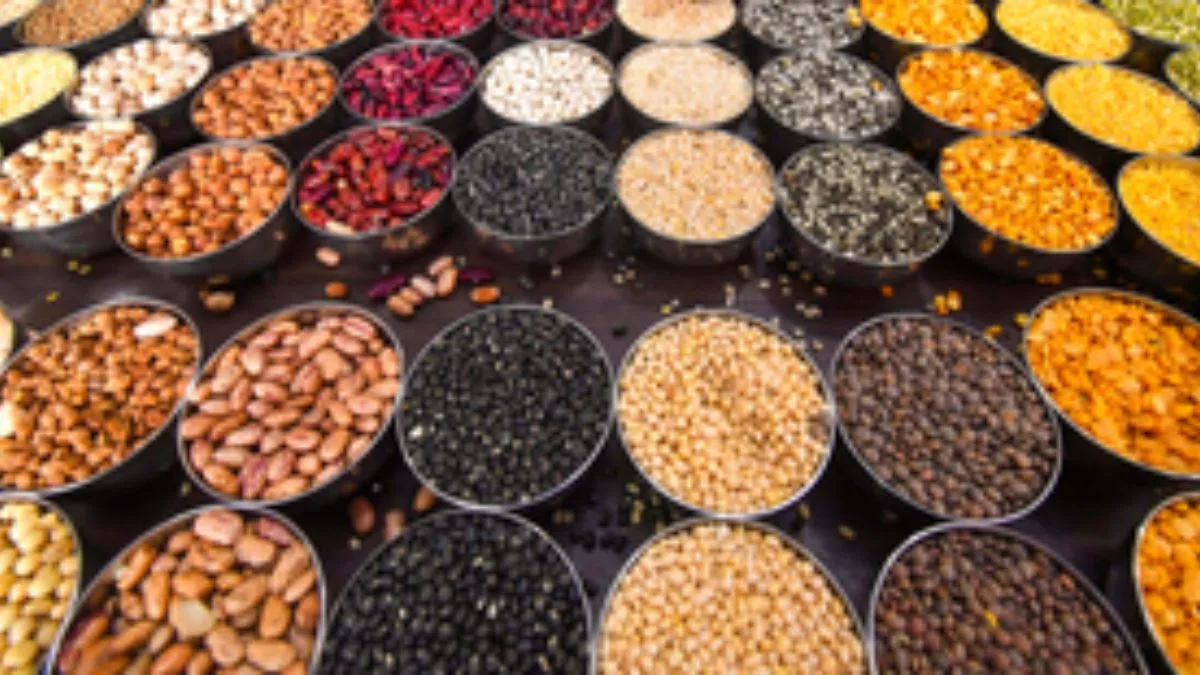
India, the world’s largest producer and consumer of pulses, has taken a significant step towards self-reliance in this critical food sector, NITI Aayog said in a report.
In its report titled “Strategies and Pathways for Accelerating Growth in Pulses towards the Goal of Atmanirbharta”, NITI Aayog lays out a detailed roadmap to accelerate growth in the pulses sector, which sustains the livelihoods of over 5 crore farmers, with nearly 80% of production dependent on rainfed areas.
Advertisement
The NITI Aayog report projected that domestic supply will reach 30.59 MT by 2030 and 45.79 MT by 2047 under a business-as-usual scenario. However, with strategic interventions, output could climb to 48.44 MT by 2030 and 63.64 MT by 2047.
India’s pulse output, which had fallen to 16.35 million tonnes (MT) in 2015–16, leading to heavy imports, rebounded to 26.06 MT by 2022–23, marking a 59.4% rise in production and reducing import dependence from 29% to 10.4%.
It further highlighted India’s diverse agro-climatic conditions, which allow the cultivation of 12 different pulses, though production remains concentrated in a handful of states, with Madhya Pradesh, Maharashtra, and Rajasthan together contributing 55%.
Notably, the Union Budget 2025–26 has announced a six-year Mission for Atmanirbharta in Pulses, with a focus on pigeonpea, black gram, and lentils.
It noted that the framework rests on two pillars, namely horizontal expansion, through the use of rice fallow lands and intercropping; and vertical expansion, through yield improvement, technology adoption, and scientific farming practices.
It also proposes a district-wise quadrant approach, focusing on 111 high-potential districts that account for 75% of the national output.
Key recommendations include crop-wise clustering, high-quality seed distribution, “One Block-One Seed Village” hubs supported by farmer producer organisations (FPOs), and proactive climate adaptation measures.
The report also stresses the need for data-driven monitoring and decision-support systems to drive a transformation in the sector.
Recognising self-sufficiency in pulses as a national priority, the report positions India on a trajectory to reduce imports, ensure nutritional security, and promote sustainable agriculture in line with the government’s Atmanirbharta vision.